Yard grading and drainage in Dalton and Whitfield County
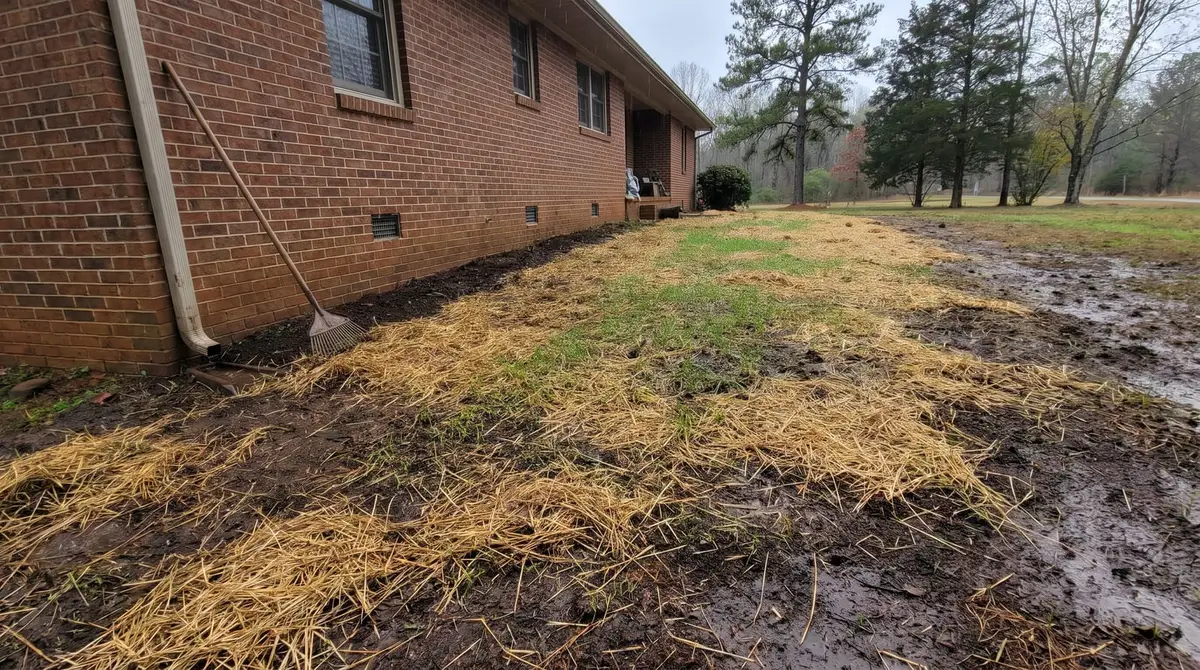
If rain puddles against the house, the crawl space stays damp, or one corner of the yard never dries out, the ground is usually sloped the wrong way. Regrading reshapes the soil so water runs away from the house instead of toward it, and around a typical home it often costs $1,000 to $3,000.
Call (706) 229-7411Rather not call? Send the detailsCalls are answered weekdays, 9 to 6. After hours, leave your name, address and what's going on, and you'll get a call back first thing the next business day.
How do I know my yard needs regrading?
The clearest sign is water that collects against the foundation after rain. Walk the yard after a heavy storm and look for these:
- Water by the walls: Puddles or wet mulch right against the foundation, or a musty, damp crawl space.
- Soil washing out: Bare streaks, exposed roots, or mud fanning across the driveway or patio after storms.
- Low spots that stay wet: Areas that stay soggy for days, kill the grass or breed mosquitoes.
- Ground settled toward the house: Backfill around newer homes often sinks over the first few years and tips the slope back toward the walls.
One wet spot after a downpour is normal. A pattern that repeats every rain is what grading fixes.
What slope should the ground have around a house?
The residential building code Georgia uses says the ground should fall at least 6 inches within the first 10 feet from the foundation. That first 10 feet does most of the work: get water moving away there, and the rest of the yard can be gentler.
Where a lot is too tight to get 6 inches of fall, the code allows swales, shallow channels that carry water around the house, or drains that pipe it away. A grading crew can tell you which your yard needs.
Why is drainage such a common problem around Dalton?
Dalton sits in Georgia's Valley and Ridge country, where long ridges such as Rocky Face Ridge stand over valleys underlain by shale and limestone. Water comes off those slopes fast, and many lots are cut into hillsides.
The area also gets a lot of rain: about 55 inches a year at the nearest NOAA rainfall station, in Chattanooga. With that much water, a yard that is a little off becomes a yard that is wet all winter.
What happens on a regrading job?
- Look and measure: The crew checks where water goes, measures the fall away from the house, and marks utilities after a call to Georgia 811.
- Move the soil: They cut high spots and add fill where the ground has sunk, usually with a skid steer or small dozer.
- Shape and compact: The surface is shaped to the planned slope and firmed so it does not settle back.
- Finish: Topsoil, seed or straw goes down so the new grade holds through the next storms.
How much does yard grading cost around Dalton?
As a rough guide for 2026, HomeGuide's national figures put most yard grading jobs at $500 to $5,000, about $0.40 to $2.00 a square foot, with grading around a whole house at $1,000 to $3,000. Hauling in fill dirt, removing old landscaping, or a tight backyard a machine can barely reach push it higher.
If water still needs somewhere to go after grading, a French drain or swale is the usual add-on.
Common questions
Do I need a permit to regrade my yard in Whitfield County?
Usually not for a typical yard. The county requires a land-disturbance permit for work over an acre, inside a subdivision developed after 2000, or within 200 feet of a year-round stream. Ask the crew to confirm for your lot.
When is the best time to regrade?
In dry weather, when the soil can be shaped and compacted without turning to mud. Seeding goes best in spring or fall.
Can I regrade my yard myself?
Small touch-ups along a foundation can be done with a shovel, a rake and a bag of topsoil, as long as the ground still falls away from the house. Moving more soil than that usually means a skid steer, and any digging with a machine needs a Georgia 811 call at least 3 business days ahead.
Will regrading fix a wet crawl space?
Often, if the water is coming from surface runoff. If it comes up from groundwater, a drain or crawl space work may be needed too.
Sources: International Residential Code 2024, R401.3 Drainage (adopted in Georgia with amendments) (source); New Georgia Encyclopedia, Valley and Ridge geologic province (source); NOAA 1991–2020 climate normals, Chattanooga airport (nearest rainfall normal to Dalton) (source); Whitfield County Engineering, Land disturbance: what requires a permit (source); Georgia 811, the 811 process (source); HomeGuide, Cost to level or regrade a yard (Jan 2026) (source).
Last reviewed October 31, 2026.
Rather not call? Send the details
A local grading pro will call you back.