Gravel driveways in Dalton and Whitfield County
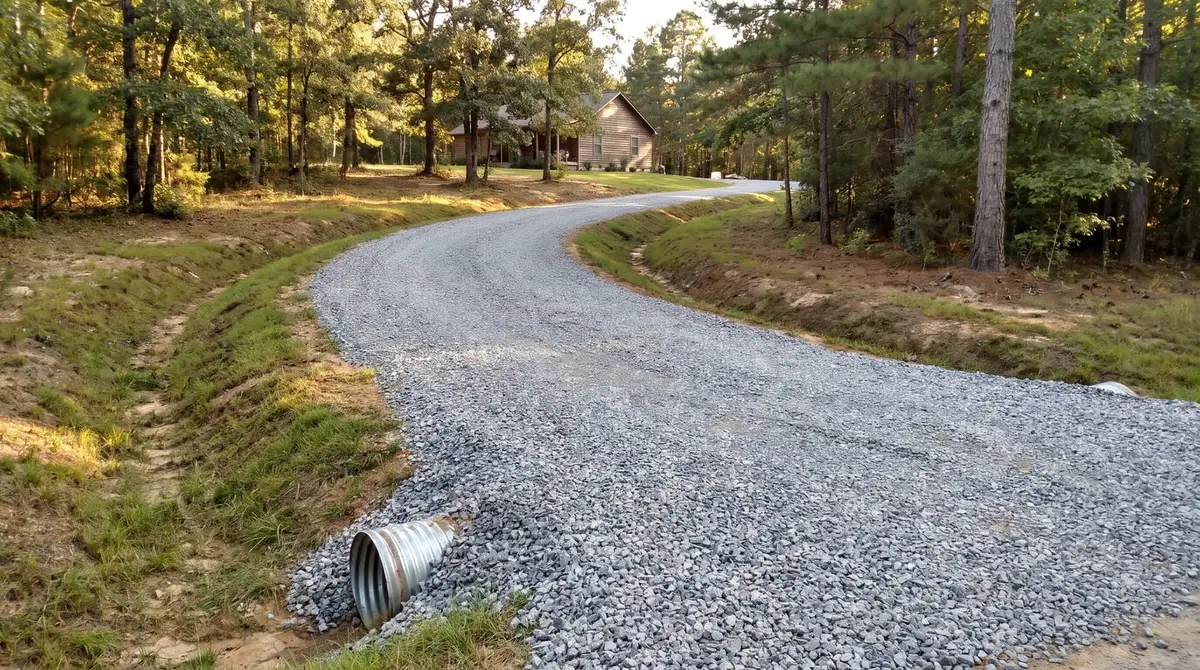
A gravel driveway is cheaper than concrete and suits long rural drives, but it only stays smooth if the base under it is built right. Most ruts, potholes and washouts come from a thin base or water running across the drive, not from the top stone.
Call (706) 229-7411Rather not call? Send the detailsCalls are answered weekdays, 9 to 6. After hours, leave your name, address and what's going on, and you'll get a call back first thing the next business day.
How should a gravel driveway be built?
- Strip and shape: Topsoil and roots come out, and the ground underneath is shaped and compacted into a firm subgrade.
- Fabric: A layer of filter fabric over soft ground keeps soil from pushing up into the stone.
- Base: A thick layer of crushed stone is spread and compacted in lifts. This is the part that carries the weight.
- Top: A thinner layer of clean stone finishes the surface.
- Crown and ditches: The drive is crowned slightly in the middle with shallow ditches or swales at the edges, so rain runs off instead of down the middle.
Why does my gravel driveway keep washing out?
Water is the usual culprit. On sloped lots, rain finds the drive and runs straight down it, carrying stone with it. Around Dalton, with long ridges and about 55 inches of rain a year, a drive without a crown, ditches or a culvert at the low point rarely stays put.
Potholes and soft spots usually mean the base is too thin or soil has mixed into the stone. Adding more top gravel hides the problem for a season; rebuilding the base fixes it.
Can an old gravel driveway be repaired?
Often. A grader or skid steer can cut out ruts, restore the crown and pull stone back from the edges. Low spots can be built up with new base, and a culvert or ditch can turn water off the drive.
If the drive sinks everywhere or turns to mud each winter, the base has failed and a rebuild costs less over time than repeated top-ups.
How much does a gravel driveway cost around Dalton?
As a rough guide for 2026, HomeGuide's national figures put new gravel driveways at about $4 to $10 a square foot, roughly $4,000 to $10,000 for a 100-foot drive 10 feet wide. Clearing, culverts, fabric and the depth of the base move the price most.
Ask each crew how thick the compacted base will be and what stone they use for base and top, so quotes compare like for like.
Common questions
How thick should the gravel be?
It depends on the soil and the traffic. The base is what matters; ask for the compacted thickness in writing rather than tons of top stone.
Do I need a culvert?
If the drive crosses a ditch or a low spot where water flows, yes. Without one, water cuts across the drive and washes it out.
Gravel or concrete?
Gravel costs less up front and is easy to repair; concrete costs more but needs little upkeep. Long rural drives are usually gravel.
Sources: New Georgia Encyclopedia, Valley and Ridge geologic province (source); NOAA 1991–2020 climate normals, Chattanooga airport (nearest rainfall normal to Dalton) (source); HomeGuide, Gravel driveway cost (Dec 2025) (source).
Last reviewed October 31, 2026.
Rather not call? Send the details
A local grading pro will call you back.